Author Archives: ngwright

Blackness Castle

Just made a day trip to Blackness Castle. The castle is on the shores of the Firth of Forth in West Lothian, about 2 miles from Bo’Ness and fairly  near Edinburgh.

The castle is unique in that it is remarkably complete. It was built in the 15th century and has been in almost continuous use for most of its life. It protects the Forth and the port of Linlithgow, and though it is smaller than the castles in Stirling or Edinburgh it has seen numerous sieges over its history.

The landscape offers excellent defense and the walls here are extremely thick. From the outside, the castle design greatly resembles that of a ship, which is new one for me.

The village of Blackness is very tiny – not so much as a shop, cafe, or pub (that was open) and just a few houses.

I’m guessing this relatively remote location made the castle a perfect place to store ammunition which was its primary function from 1870 up until WWI. It was also a minor military barracks, but its primary purpose (other than defense was as a prison. The castle itself has a very rugged and one could argue grim appearance (nothing like picturesque Urquhart or Castle Campbell), but you can see a natural beauty there as well in the way it rises out of landscape.

At the time Blackness Castle was built Linlithgow was the primary royal residence and Blackness was the primary port – the castle was built by the Crichton’s but soon passed to James II. Fortifications were added in the mid 16th century making it one of the most advanced artillery forts in Scotland, but that didn’t prevent it from falling to Cromwell’s army a century later.

It was recently used during filming for the movie Doomsday.

Travelling around the countryside is not so easy when you don’t have a car, I managed to get the train to Linlithgow and a bus from there to Blackness. Unfortunately there are only four buses a day that go Blackness so rather than wait around for another 2.5 hours in a village with no pub or cafe I walked back to Bo’Ness  along the shore route to catch a bus from there – its nice to feel like you have the time to take an impromptu 90 minute hike, especially since it did get me home an hour sooner.
Tagged , , , , , , , ,

Foraging at the Edinburgh Botanical Garden

As part of the Edinburgh Science Festival, Aarti and I went to a foraging workshop and breakfast this past weekend – completely her idea but I enjoyed it immensely.

Originally, I was not so keen on having such an early start on a Saturday morning, but as I started to wake up a bit more I began to get more into it. The event was at the Edinburgh Botanical Garden. A foraging expert and a local botanist toured us around while pointing out edible plants along the way and giving us some pointers about how to identify them in the wild and also how you’d prepare some of these things in your own kitchen.

I guess the event was pretty popular because there were more than 60 people there by my count. They broke it up into two groups to make the logistics a bit easier.

The forager who showed our group around was named Miles Irving, he’s the author of A Foragers Handbook and has supplied some London restaurants with foraged food.

I was interested to hear him explain about how much of his plant knowledge is self taught.  I don’t have much experience with botany, but I think it would be difficult to learn so much of that on your own – especially since misidentifying something could make you really sick. There was a botanist also who seemed to know the Botanics really well; he also knew the latin names for most everything which was slightly intimidating but I felt like we were in good hands.

I don’t think I’d want to forage for all of my meals, but you can see that there are some definite health benefits to such a lifestyle. I find it very easy to recognize that foragers consume a far greater variety of nutrients and have a more protein rich diet than the average person.

A lot of that local plant knowledge is a mystery, and its refreshing to see a few people trying to reintroduce us to those foods that were a dietary staple for such a long time but had been largely forgotten since we all started going to Tesco’s.

Probably the most memorable thing was the birch tree which had been tapped a couple days before the event. Apparently, there is only a few weeks out of the year when you can tap one (usually end of March, early April) but during that time they can produce huge quantities of sap. I can’t remember exactly what they planned to make with it, but I think they said the plan was to make syrup or honey or something like that.  I remember a couple Maple Syrup commercials that showed them tapping the Maple trees in Quebec, but I never realized there was such a small window of time for this to happen.

The breakfast that followed was really nice but Aarti and I felt a little bit jipped because they ran out of muffins before we got to the buffet. They had these venison sausages from a butcher in Portobello that were incredible and there was also porridge served with wild berries, an egg pot with mushrooms and some special potato cake with herbs. All made at least partially with foraged ingredients.


Tagged , , , , , , ,

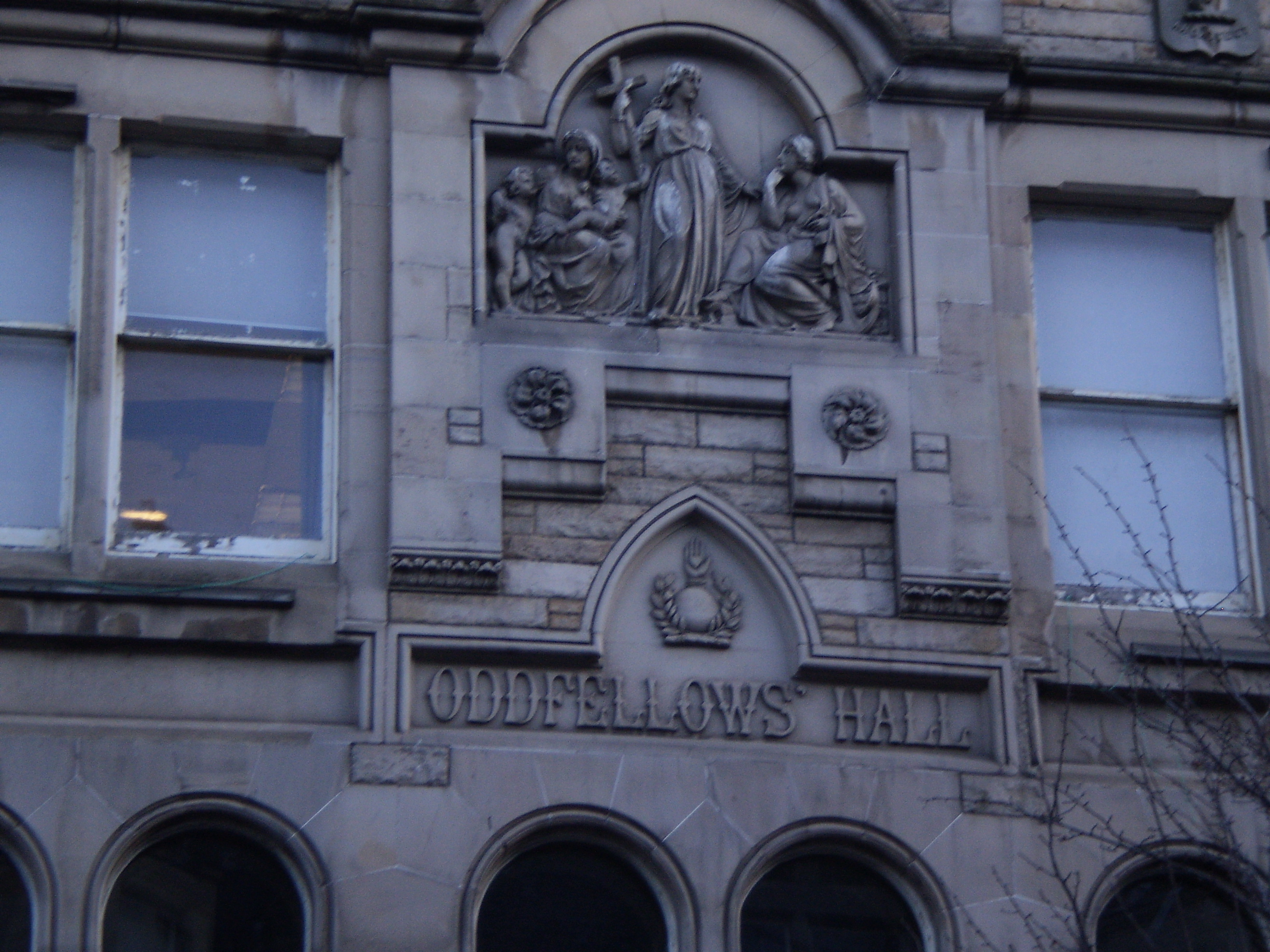
Oddfellows Hall – Edinburgh

I often walk by this building on my way to the gym in Quartermile, and was a little perplexed by the strange, but incredibly detailed carving that stands out even in a city known for fine masonry. Plus, the name was begging for a more exhaustive Google search to quench my curiousity.

Of course there are fraternal societies in Canada that I am a little aware of,  but I never really understood their meaning growing up and was put off by the occasional pomp and ceremony.

I now know that term Oddfellows comes from medieval times and the modern group developed from early guilds: in small communities men coming from an ‘odd’ assortment of trades would form these societies for an early form of social support. Members would lend a helping hand to each other in times of sickness or financial hardship.

Normally, guilds were made up of the apprentices (trainees), journeymen or fellows (wage earners), and masters (owners/managers). However, fellows and apprentices were marginalized under this system. Masters would make special uniforms a prerequisite for attending meetings and set up other regulations to keep the lower orders from being active in the guild. In response, apprentices and fellows set up yeoman guilds  to counter the influence of the masters.  These gatherings of working people were a precursor to the modern day labour movement and caused substantial concern among those in government. These organizations were even illegal for a long time.

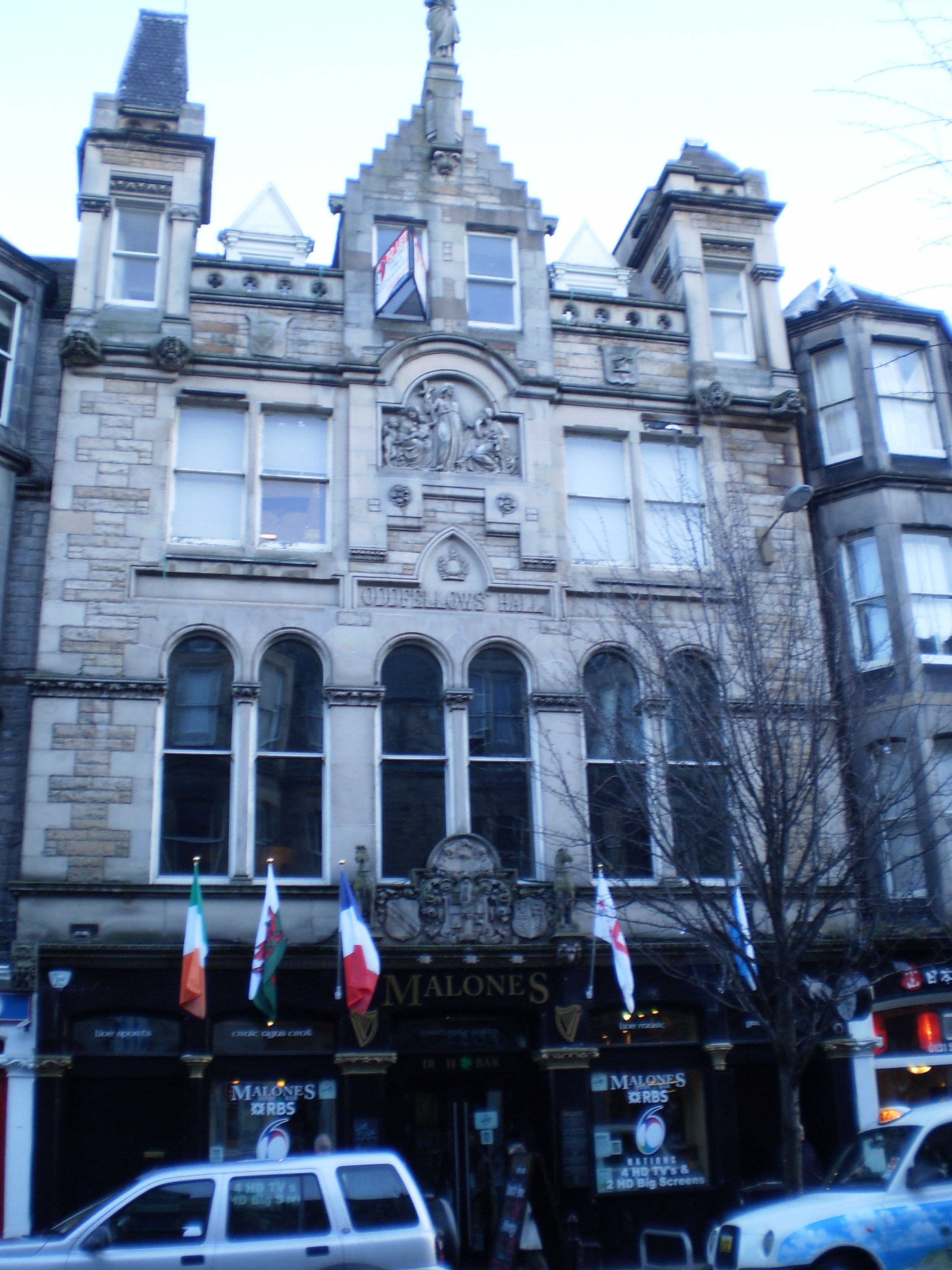
Oddfellows Hall / Malones Irish Pub

Oddfellows Hall was converted to a pub which is now Malone’s Bar on Forrest Road near Edinburgh University. This area is a hub for some extremely odd but very entertaining folk during the Edinburgh Festival.

There was a big remodel a few years before I moved here, but I found some excellent photos on this architecture blog.

Its a pretty good pub to hear some live music or watch a big rugby or football match since there is a lot of space. Not surprising because of its convenient location, university students are the primary patrons nowadays. The Oddfellows are still around but the only branch left in Scotland is over in Kilmarnock.  I suppose there wasn’t as much demand for these fraternities after the 1960’s as government took over more social welfare responsibilities and trade unions grew, membership in these organizations shrank. Still, it was nice to read up on their history and take a closer look at such an interesting Edinburgh building.

Tagged , , ,

The Second Visit to Stirling Castle

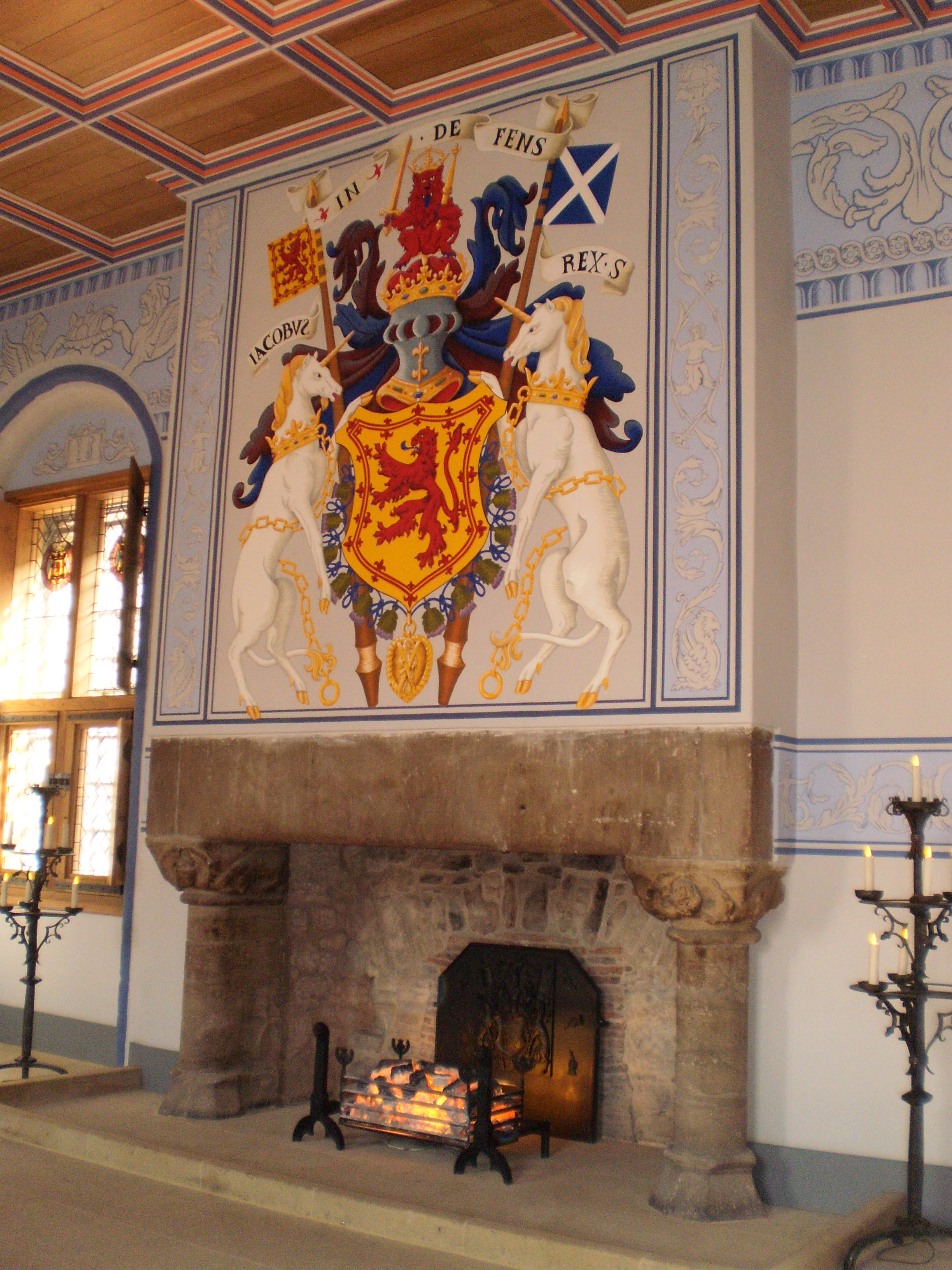
During my first visit to Stirling Castle (18 months ago) I was disappointed to find a large section closed off for renovations. The Royal Apartments were being done up to look like they would have during the time of Mary of Guise, widow of James V and mother of Mary Queen of Scots. Stirling was the seat of power for several Stuart Kings, and since her husband James V died before they would have been completed, Mary of Guise ruled from these apartments as regent.

Stirling was one the most strategically important castles of the time, and has great natural defenses. The entire old town sits atop an extinct volcano overlooking the River Forth and the primary route from the Highlands to the lowlands passed through the town.

The castle changed hands several times during the war of independence and Robert the Bruce’s eventual victory at the Battle of Bannockburn took place nearby. However, most of the current buildings are from the 15th and 16th centuries as Stirling increased in its importance as a royal residence. James V wanted his palace to be grand, and impress any other European ruler coming through its gates, particularly his new bride Mary of Guise.

In a lot of ways, there is far more to see at Stirling’s castle than there is at Edinburgh Castle. There is the Great Hall, the Royal Apartments, the kitchens, the regimental museum, the tapestry studio, and Argyll’s Lodging just a short walk away. Plus, in the hour and change before Aarti’s train got there I got to walk around a bit, and I made it over to the heading hill where the beheading stone sits.

I really liked the short walk around Argyll’s lodging. The tour guide seemed really knowledgeable and enthusiastic about the evolution of the house and how each of the owners put their touches on it.

We even bought a bottle of nice local Drumgray whisky liqueur from the castle shop, which Aarti and I opened tonight. Even though there are some similarities, it tastes very different than bailey’s. Drumgray uses a single malt whisky and a scottish double cream.

Tagged , , ,

Bus fares are going up again in Edinburgh

Having lived in Edinburgh for less than two years, I have now witnessed two separate fare increases on Lothian Buses.

Lothian buses is publicly owned, and they are taking some serious heat for the latest round of fare hikes. They claim increased costs and cuts to government subsidies. Even though bus service is generally quite good, I see no apparent improvement in service hours or frequency as a result of the second annual fare increase.

Lothian buses are the primary operator for municipal buses in Edinburgh, but First Bus company (which is private) also operates in the city.  In Canada, municipal bus service is almost always operated by local governments or crown corporations.

That doesn’t always mean affordability, but in the UK there is a long nasty history of privatization in the transport sector. In most cases, service levels dropped and fares increased when train and bus routes were contracted out to private companies. Those companies slashed wages and cut staff levels, and several still couldn’t stay in business. Political pressure forced the government to intervene.

I’m told that bus drivers actually do quite well here in terms of salary, but I don’t really see users getting as much value here as they should be. The bus routing is not well done. Part of that can be attributed to the poor Edinburgh road system, and the current tram works on Princes street. However, even before that, there was always a logjam of buses on Princes Street and in the rural areas outside of Edinburgh, its common to see those big double decker buses with fewer than ten people on them.

There is only one express bus (to the airport) and you pay a premium to use that. You also have to pay a premium fare to travel on the night buses (even if you have a monthly pass).

Its difficult to make a direct comparison in service levels, but I was curious about just how those fares compared to my own country. I tried to focus on cities that were similar to Edinburgh, didn’t have metros or LRT systems, and were the central city for their region (not a suburb of a larger metro).

When I did the currency conversions, I found that single journey tickets and day passes in Edinburgh are still quite cheap compared to Canada, but you can often spend less in Canada on monthly passes, particularly when you factor in the public transit tax credit. There are concessions in Edinburgh as well, mainly the Scottish National Entitlement Card, which allows some young people and anyone over 6o or disabled to travel on the bus for free.

City Transit Operator Single Cash Fare DayPass Monthly Pass
Edinburgh, Scotland (pop. 486,000) Lothian Buses £1.40 £3.50 £51.00
Victoria, British Columbia, Canada (pop. 345,000) BC Transit £1.58 £4.91 £53.94
Quebec City, Quebec, Canada (pop. 516,000) Reseau de transport de la Capitale £1.62 £4.34 £47.40
Winnipeg, Manitoba, Canada (pop. 663,000) Winnipeg Transit £1.62 N/A £48.82
Hamilton, Ontario, Canada (pop. 692,000) City of Hamilton £1.62 N/A £55.11
Halifax, Nova Scotia, Canada(pop. 403,000) MetroTransit £1.42 N/A £44.33
Tagged , , , , , , , , , , , ,

Trainspotting at The Scotsman Hotel Cinema

For the longest time I didn’t know that there was a cinema in the basement of the Scotsman Hotel. When Aarti told me about it, I was very excited to check it out.

I had a picture in my head of one of those private screening rooms that people used to put in their houses, but was pleased to find out that it felt like a proper movie theatre… except with bigger comfier seats.

It was the two year anniversary of the Edinburgh Cinema Meetup Group and the film Trainspotting was chosen by popular vote.

I’d seen it before, but plenty of time had passed so I was a little hazy on some of the details.

It stars Ewan McGregor, Johnny Lee Miller, Robert Carlyle, and introduced Scottish actress Kelly MacDonald (who is now becoming famous for her role in Boardwalk Empire). It was directed by Danny Boyle and is based on a novel by Irvine Welsh (who has a small cameo in the film).

Welsh is from Leith (where I live), so even though the film is fifteen years old there are plenty of recognizable locations including the worst toilet in Scotland.

This is the Port O Leith Bar, which is out by the shore. Its a little better than it was in Welsh’s day, but I’m told it can still be a pretty rough place.

There is also a scene where the main characters are being chased down Princes street for shoplifting, and I was amazed at how remarkably similar the street looked compared to today.

There are plenty of memorable scenes from the movie, many of them disgusting. One that always freaked me out was Ewan McGregor coming off Heroin after having an overdose. He has some pretty disturbing hallucinations including one where he is being attacked by a dead baby crawling on the ceiling.

However, probably my favourite was the scene where after getting off at one of the most remote train stations in Scotland at Corrour near Loch Ossian, Ewan McGregor’s character gives an awesome speech about what it means to be Scottish.

When I saw the whole rant on a T-shirt, I very nearly bought it.

Tagged , , , , , , , ,

Opening of the Scottish National Portrait Gallery

I’d been waiting for this gallery to re-open since I arrived in Scotland, and managed to go in early December. It has been undergoing renovations for the whole time I have been in Edinburgh as it expands into the entire building of its traditional Queen Street location. Finally getting inside is more than just idle curiousity.  More than just the artwork, the building is exceptional for many reasons. It is done in this red sandstone which is rare in Edinburgh and the statues placed overlooking the surrounding streets represent key figures in Scottish history and are all of amazing quality even though they are still shielded behind the protective black netting.

This is quite common in old Scottish buildings under restoration. Its my understanding that it keeps birds off the delicate areas and protects the public should a piece break off and fall.

Because I have been many times to the National Gallery on Princes Street some of the paintings and sculptures were a little familiar but most of it was entirely new for me. In the main hall, there was a huge Christmas tree and about 8 marble busts of important figures in Scottish history like Sir Walter Scott, Robert Louis Stevenson, James Watt and others. When you look up, you see these murals between the different levels, with an even larger collection of historical figures. It was meant to be a kind of incomplete encyclopedia.

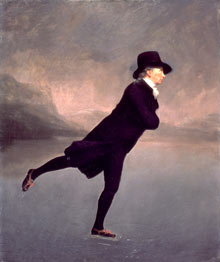
The Portrait Gallery is also home to a massive collection of photographs. An abstract painting of a young Billy Connolly guards the elevator a short distance from photographs of Sean Connery, James McEvoy, and other Scottish celebrities. Famous paintings of Robert Burns by Alexander Nasmyth and Sir Walter Scott by Henry Raeburn hang in the gallery. Henry Raeburn was one of the most famous Scottish artists and achieved remarkable success in his day, and the gallery includes many of his finer works. He painted many in the Scottish aristocracy, but has become best known for his portrait of the skating priest on Duddingston Loch which now hangs in the Princes Street Gallery.

The Skating Minister by Henry Raeburn

I liked the library very much. It had old copies of Treasure Island and busts of Burns and Stevenson, and a rather bizare portrait of JK Rowling. Old Victorian libraries are not the most functional of places but they did know their furnishing and how to study in fine surroundings.  

I found the murals on the 1st level to be very educational. You’d expect to see the Battle of Bannockburn, but you also see a lot of other events in Scottish history that are not frequently portrayed in the present day. Its a disadvantage of getting so much history knowledge from television programs and Neil Oliver from the BBC. Before widespread literacy, this is how people would visualize their history.

Tagged , , , , , , , , , ,

The Mysterious Rosslyn Chapel

Despite numerous recommendations, I admit that I never bothered to read the Davinci Code.  Even when they made it into a movie, I waited until it came out on dvd before finally seeing what all the fuss was about.

One of the scenes I remember well is when Tom Hanks and Audrey Tautou discover the waiting members of the Priory of Scion at Rosslyn Chapel.

Before coming to Scotland, I was not surprised to learn that Rosslyn Chapel was attracting plenty of tourists long before getting Davinci Code publicity. Not only was it was a key stop among wealthy Victorians who were exploring the rich architecture of the Borders, but it was also an important pilgrimmage site for its connection to the Knights Templar, Free Masons, and the Holy Grail.

I’m not the type to believe in conspiracy theories, but after visiting it in person I can tell why so many people believe there is more of a story to this beautiful building.  The number of carvings and their beauty and precision is incredible for such a small church in a small village. It’s about a 40 minute bus ride from Edinburgh City Centre.

The 15th Century Rosslyn Chapel was initially intended to be much larger, but its founder, William St. Clair died before it could be completed.

Inside the chapel, there are 110 green men carvings. The exact meaning of them is not very clear, but they usually appear as a face with greenery around them and roots protruding from the mouth. They’re thought to be a symbol of fertility and renewal, and are believed to be pre-Christian in origin. It might seem odd to find pagan symbols in a Christian church, but these green men can be found in many other UK churches. There are many other Christian rituals and symbolism that can be traced back to pagan traditions.

The chapel itself is filled with images of animals and nature. There is a carving that many believe to be corn / maize from many years before North America was discovered.  Some take this as proof that William’s ancestor Henry had visited North America – some suspect that Henry was a member of the Knights Templar.

photo taken November 19, 2011

There is also a legend about the carved pillars in Rosslyn. St. Clair wanted one of the pillars to be based on a design that he had seen in Rome. Before beginning the work, the master mason wanted to study the pillar for himself so he journeyed to Rome. Travelling was far more difficult in those days, and such a trip would have taken him years. While he was away, his apprentice wanted to carve the pillar himself and when the master mason returned, he saw a pillar that overshadowed his own and flew into a rage. He struck his apprentice on the head with a mallet, killing him. The mason was convicted of the murder and executed, and a carving was produced so he would be forced to look down on his apprentice’s pillar for all eternity.

The crypt below the chapel has been sealed for centuries, which has fueled rumours of what might be buried there. It could be the remains of Mary Magdalene, the treasure of the Knights Templar, or even the Holy Grail itself. No one really knows.

An extensive search for an entrance was made in the 19th century, but none was found.

I don’t really believe in these myths of the Knights Templar or Free Masons, but Rosslyn Chapel is an architectural marvel and more than a fine example of medieval masonry. Its amazing how much of it has been preserved considering it was left empty for so many years.

Due to a problem with the damp, a protective cover (recently removed) was placed over it for nearly ten years while restoration work was done. Conservation work is still in progress, but most areas were accessible.

A new cafe, gift shoppe, and ticket center was also built to accommodate the tens of thousands of tourists visiting the chapel.

Tagged , , , , , , , , , ,

Oban: 30 minutes of fireworks in 1 minute

A coworker was telling me about this; the technical fuckup got more attention for Oban than any Bonfire night show.


Tagged , , ,