Monthly Archives: December 2011

Opening of the Scottish National Portrait Gallery

I’d been waiting for this gallery to re-open since I arrived in Scotland, and managed to go in early December. It has been undergoing renovations for the whole time I have been in Edinburgh as it expands into the entire building of its traditional Queen Street location. Finally getting inside is more than just idle curiousity.  More than just the artwork, the building is exceptional for many reasons. It is done in this red sandstone which is rare in Edinburgh and the statues placed overlooking the surrounding streets represent key figures in Scottish history and are all of amazing quality even though they are still shielded behind the protective black netting.

This is quite common in old Scottish buildings under restoration. Its my understanding that it keeps birds off the delicate areas and protects the public should a piece break off and fall.

Because I have been many times to the National Gallery on Princes Street some of the paintings and sculptures were a little familiar but most of it was entirely new for me. In the main hall, there was a huge Christmas tree and about 8 marble busts of important figures in Scottish history like Sir Walter Scott, Robert Louis Stevenson, James Watt and others. When you look up, you see these murals between the different levels, with an even larger collection of historical figures. It was meant to be a kind of incomplete encyclopedia.

The Portrait Gallery is also home to a massive collection of photographs. An abstract painting of a young Billy Connolly guards the elevator a short distance from photographs of Sean Connery, James McEvoy, and other Scottish celebrities. Famous paintings of Robert Burns by Alexander Nasmyth and Sir Walter Scott by Henry Raeburn hang in the gallery. Henry Raeburn was one of the most famous Scottish artists and achieved remarkable success in his day, and the gallery includes many of his finer works. He painted many in the Scottish aristocracy, but has become best known for his portrait of the skating priest on Duddingston Loch which now hangs in the Princes Street Gallery.
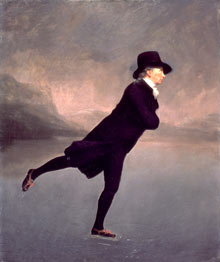
The Skating Minister by Henry Raeburn

I liked the library very much. It had old copies of Treasure Island and busts of Burns and Stevenson, and a rather bizare portrait of JK Rowling. Old Victorian libraries are not the most functional of places but they did know their furnishing and how to study in fine surroundings.  

I found the murals on the 1st level to be very educational. You’d expect to see the Battle of Bannockburn, but you also see a lot of other events in Scottish history that are not frequently portrayed in the present day. Its a disadvantage of getting so much history knowledge from television programs and Neil Oliver from the BBC. Before widespread literacy, this is how people would visualize their history.

Tagged , , , , , , , , , ,

The Mysterious Rosslyn Chapel

Despite numerous recommendations, I admit that I never bothered to read the Davinci Code.  Even when they made it into a movie, I waited until it came out on dvd before finally seeing what all the fuss was about.

One of the scenes I remember well is when Tom Hanks and Audrey Tautou discover the waiting members of the Priory of Scion at Rosslyn Chapel.

Before coming to Scotland, I was not surprised to learn that Rosslyn Chapel was attracting plenty of tourists long before getting Davinci Code publicity. Not only was it was a key stop among wealthy Victorians who were exploring the rich architecture of the Borders, but it was also an important pilgrimmage site for its connection to the Knights Templar, Free Masons, and the Holy Grail.

I’m not the type to believe in conspiracy theories, but after visiting it in person I can tell why so many people believe there is more of a story to this beautiful building.  The number of carvings and their beauty and precision is incredible for such a small church in a small village. It’s about a 40 minute bus ride from Edinburgh City Centre.

The 15th Century Rosslyn Chapel was initially intended to be much larger, but its founder, William St. Clair died before it could be completed.

Inside the chapel, there are 110 green men carvings. The exact meaning of them is not very clear, but they usually appear as a face with greenery around them and roots protruding from the mouth. They’re thought to be a symbol of fertility and renewal, and are believed to be pre-Christian in origin. It might seem odd to find pagan symbols in a Christian church, but these green men can be found in many other UK churches. There are many other Christian rituals and symbolism that can be traced back to pagan traditions.

The chapel itself is filled with images of animals and nature. There is a carving that many believe to be corn / maize from many years before North America was discovered.  Some take this as proof that William’s ancestor Henry had visited North America – some suspect that Henry was a member of the Knights Templar.

photo taken November 19, 2011

There is also a legend about the carved pillars in Rosslyn. St. Clair wanted one of the pillars to be based on a design that he had seen in Rome. Before beginning the work, the master mason wanted to study the pillar for himself so he journeyed to Rome. Travelling was far more difficult in those days, and such a trip would have taken him years. While he was away, his apprentice wanted to carve the pillar himself and when the master mason returned, he saw a pillar that overshadowed his own and flew into a rage. He struck his apprentice on the head with a mallet, killing him. The mason was convicted of the murder and executed, and a carving was produced so he would be forced to look down on his apprentice’s pillar for all eternity.

The crypt below the chapel has been sealed for centuries, which has fueled rumours of what might be buried there. It could be the remains of Mary Magdalene, the treasure of the Knights Templar, or even the Holy Grail itself. No one really knows.

An extensive search for an entrance was made in the 19th century, but none was found.

I don’t really believe in these myths of the Knights Templar or Free Masons, but Rosslyn Chapel is an architectural marvel and more than a fine example of medieval masonry. Its amazing how much of it has been preserved considering it was left empty for so many years.

Due to a problem with the damp, a protective cover (recently removed) was placed over it for nearly ten years while restoration work was done. Conservation work is still in progress, but most areas were accessible.

A new cafe, gift shoppe, and ticket center was also built to accommodate the tens of thousands of tourists visiting the chapel.

Tagged , , , , , , , , , ,